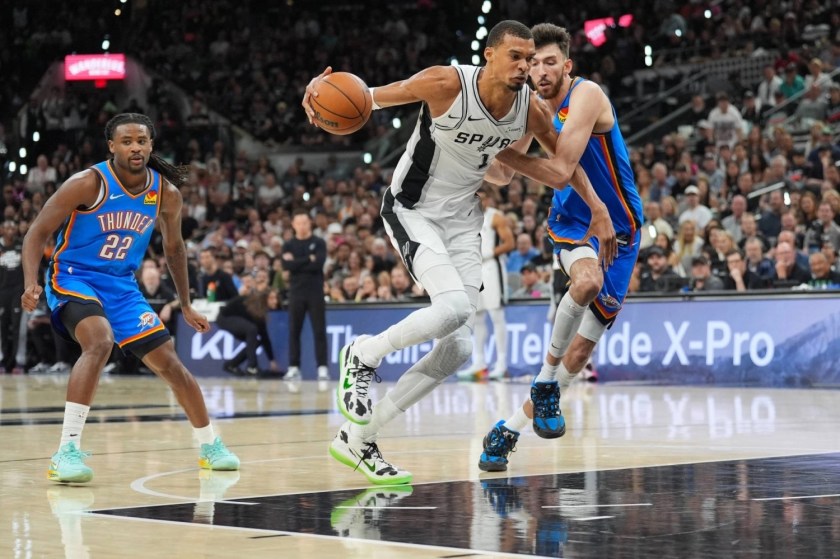
Championship-caliber teams are often defined not by how they win, but by how they react after a humiliating defeat. And the San Antonio Spurs delivered their response last Sunday night. With a vengeance never seen from a team that was uncompetitive for quite a while.
Still licking their wounds from the humiliating Game 3 loss, when Oklahoma City’s reserves disrespected their homecourt and embarrassed them in front of their own fans, the Spurs struck back with their most complete performance of the postseason yet; dismantling the Thunder 103-82 to level the Western Conference Finals at two games apiece. That 21-point win was the biggest by far in this series. It signifies that the victory was not merely a bounce-back win. It was a big-bad-bully statement. It was a declaration that San Antonio remains very much alive in this series; it would not bend a knee – and that the Game 3 loss was just a fluke and would never be repeated again. Ever.
The foundation for that response was Defense. Spelled with a capital D. Physical, relentless, suffocating, in-your-face Defense.
For most of the game until the Thunder raised the white flag of surrender, the Spurs imposed their will on OKC’s offense. Every drive was met with stiff resistance. Every passing lane seemed overly crowded. Every shot felt tirelessly contested. There was a sense of urgency that caused the Thunder to shoot a mere 33 percent from the field and a miserable 6-for-33 from three-point range while committing 20 turnovers. It was as if former Coach Greg Popovich had given them a scathing tongue-lashing when he visited them after the Game 3 debacle.
And the result was historic. OKC’s 82 points represented its lowest playoff scoring output since God-knows-when. It was clearly one of its poorest offensive performances in years. The Thunder had not even scored below 93 points in any game this season before running into this dreaded Spurs’ defensive juggernaut.
And leading the charge was Victor Wembanyama.
After Game 3, the Spurs’ young superstar publicly accepted responsibility for the loss and vowed to be more aggressive. Wemby attacked early, scored from everywhere on the floor, protected the rim with authority, and was clearly in complete control of the game’s rhythm. His final input – 33 points, eight rebounds, five assists, three blocks, and two steals – does not completely capture the extent of his impact. His shadow was present in every meaningful stretch of the game.
Yet this victory was not about Wemby alone. One of the biggest lessons from Game 3 was that San Antonio had totally underestimated OKC’s bench. The Thunder reserves outplayed the Spurs’ second unit by a proverbial mile. They swung the momentum of the game. This time, San Antonio came prepared.
The Spurs showed up with more respect for the OKC relievers – the second wave. They prepared to match OKC’s depth with renewed focus and intensity. Every OKC reserve was marked, his assignment in the OKC rotation clearly understood. The OKC rotations were studied. Defensive communication was improved. The easy confidence OKC’s backups enjoyed in Game 3 – which ultimately gave them the confidence to compete with the Spurs – vanished almost immediately.
Then there was the work of Stephon Castle. Last year’s Rookie of the Year continues to grow before our eyes on the biggest stage imaginable. Assigned once again to shadow the league MVP Shai Gilgeous-Alexander, Stephon made every possession uncomfortable. He fought over screens, stayed attached on drives, and used his athleticism to force Shai to difficult decisions. Shai still managed 19 points because superstars will always find a way, but very little came easily. The Thunder offense never found its normal flow, and Stephon’s relentless pressure was a major reason why.
Meanwhile, Oklahoma City’s injury concerns became increasingly difficult to ignore. Jalen Williams remained sidelined, depriving the Thunder of their most versatile secondary creator and defender. His absence places an enormous burden on Shai to manufacture offense. Compounding matters was the injury to Ajay Mitchell, further thinning a rotation that had looked so deep and dangerous just two nights earlier. Without those contributors, Oklahoma City struggled to generate the balanced attack that had fueled its Game 3 victory.
Now the series shifts back to Oklahoma City tied 2-2. With neither owning a clear advantage. Which feels exactly right.
Because nothing about this matchup has been predictable. One game belongs to the stars. The next belongs to the role players. One game, the offense is king. The next, the defense holds court. Momentum changes hands by the quarter. Injuries alter strategies. Young players become heroes. Veterans disappear and re-emerge. Every game seems to tell a completely different story from the one before it. One move demands a counter. Like a chess match. And that is what makes this series so compelling. It is not merely a battle for a trip to the NBA Finals; it is a collision of basketball philosophy and culture; of belief, resilience, and nerve. Four games in, and the series has been reduced to a best-of-three.
Nobody can truly predict what happens next. The only certainty is that every possession now feels enormous, every adjustment carries consequences, and every fan watching is left in awe of this crazy thing they call the playoffs. Four games in, this series has become a roller coaster of momentum swings, heartbreak, redemption, and intense competitive fire – and if the first four chapters are any indication, our series ending promises to be one of epic porportions – one that will be truly unforgettable.
Cover pic courtesy of The Japan Times.

