16th of ‘My Story’ Series
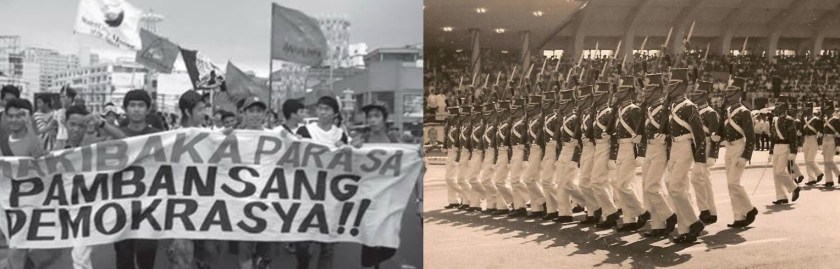
There was a time in my youth when I believed the world could be changed simply by calling the attention of the authorities and shouting slogans loud enough.
My stay at the Philippine Science High School (Pisay) opened my eyes to the many socio-economic issues that plague us. The campus environment itself seemed so full of the contradictions of the country. Beside the school was a rapidly-growing squatters’ community where poverty, crime, unemployment, and hopelessness openly festered. Every day, we’d see children running barefoot along makeshift shanties patched together from rusted tin and scrap wood. Inside the campus stood ‘Marcos-type’ buildings with leaking roofs. The school’s facilities and laboratories fell rather short of what one would expect from the country’s premier science high school. For young students constantly trained to question and think critically, these contradictions were impossible to ignore. We were surrounded by intelligence, ambition and idealism, yet there were visible signs of neglect, inequality, and systemic failure as well. It was the kind of environment where activism could easily take root and grow.
One thing I can be truly thankful to Pisay for is that it opened my eyes to the social ills of the country. Pisay is a learning institution that is known for its academics as well as for its fierce culture of student activism. The campus then was alive with clenched fists raised high against the sky, protest marches, hastily-painted streamers demanding justice for issues concerning not just the school and its environs, but issues concerning the world. Discussions inside classrooms and dormitories were not focused solely on equations and scientific theories, but more so on agitating stories of poverty, corruption, imperialism, and revolution.
At such an impressionable age, it was easy to see the world only in simple absolutes. There are oppressors and oppressed, exploiters and exploited, heroes and villains. We marched to Malacanang believing in our own grievances, believing we were the conscience of the nation. We denounced the establishment with a fiery passion that only the young can sustain. Every rally felt like a noble historical tale unfolding before our eyes.
I still remember the day my dear classmate, Francis Sontillano, died. He was hit by a pillbox hurled by a security guard from Feati University. We had planned to join the march together that day. Earlier that morning, Francis had come running from the parking lot, to tell me that the bus taking us to the rally was about to leave. But obligations with the school paper kept me from going. It was a small decision at the time; one of those ordinary moments that would later haunt me for years.
When news of his death reached us, the grief was raw and overwhelming. There were tears, disbelief, anger, and a deep sense of injustice that consumed many of us. For me, something changed after that. Every issue suddenly became intensely personal, every protest fueled less by idealism and more by rage. The campus atmosphere grew heavier, more emotional, more divisive and hateful. In the process, my studies began to suffer. I stopped caring about grades, and drifted deeper into activism and emotional turmoil.
Then came the consequences.
Eventually, I was dismissed from Pisay. One day, I was immersed in protest rallies and the social causes we passionately believed in; the next, I was on a plane back to my home province carrying nothing but disappointment, confusion, and a wounded pride. It felt as though the world I once knew had suddenly closed its doors on me.
Going home felt like a painful defeat. More than the shame, I felt that I had failed my family -especially my Papa, who had been so proud of me when I entered Pisay. Facing him again – with that proverbial ‘Failure’ written on my forehead – was one of the hardest things I ever had to do.
But the province was an entirely different world. There were no rallies there. No political manifestos. No endless ideological arguments. Life moved slowly. People worried less about changing the government and its policies; and more about harvests, fiestas, basketball games, and how to get through the week.
And so I drifted with the waves. I learned to drink. I spent nights laughing with new-found friends under dim roadside lights, beer bottles – or sometimes gallons of that native wine called tuba – scattered across rough wooden tables while we tried not to be out-of-tune with the old songs we sung. For the first time in years, I stopped arguing about changing the world and simply tried to float around, to survive my own uncertainty.
Yet somewhere deep inside me, the restlessness and the idealism that Pisay nurtured still remained. These were the ideals that clamored for justice for everyone, particularly for those who have less in life. Even far from the noise of rallies and protest marches, I still could not completely silence the questions on inequality, poverty and other issues playing in my mind.
Then came the unexpected opportunity that would change the course of my life: my admission into the Academy. To many who knew me from my Pisay days, it must have seemed odd. From a left-leaning hot-head who once marched angrily in the streets; I was now joining the very institution that produced the people who were our perceived oppressors. How could I not see through the irony?
I entered the Academy still carrying doubts, questions, and the weight of my past convictions. Some nights, I wrestled quietly with myself. Was I betraying the ideals I once believed in? Had I abandoned the causes we fought for? Or was life simply teaching me that the world was far more complicated than the slogans, the placards, and the stubborn certainties of youth?
The Academy changed me slowly. It stripped away the arrogance, the angst; forced discipline into my bones; and taught me that service to country could take many forms. I met officers who were neither monsters nor blind instruments of oppression, but honorable men willing to sacrifice comfort, safety, and even their lives for people they would never meet.
Slowly, I began to see the tragedy of our nation from both sides of the fence. As a young activist, I had once believed that meaningful change could only come by fighting the rotten system. Years later, as a cadet and eventually as a military officer, I found myself sworn to defend that same system from those who sought to overthrow it. The contradiction was never completely lost on me. Deep inside, a part of me still carried the anger of my youth against inequality and injustice; even as another part came to be more understanding of the complications and the need for order, stability, and preserving a nation from descending into chaos.
Years later, I would hear news of former colleagues from Pisay. Some had disappeared into the mountains and joined the armed struggle. Two of my former dorm roommates would become deeply involved in the movement: the late Rolando Cada and Ramon Casiple. Rollie would eventually die fighting for the cause he believed in. He would later be honored by having a rebel unit named after him: the Rolando Cada Brigade. Mon would be captured, released, and in later years, emerge as one of the country’s most respected political analyst. Others surrendered after years of hardship. Some simply vanished into the long shadows of conflict, their stories unfinished, their dreams swallowed by war and time.
Still, there are times when I wonder how a man’s convictions are formed. Looking back now, I realize that beliefs are not shaped by ideology alone, but by the very environment we live in, and the experiences and burdens life asks us to carry. In Pisay, that youthful idealism fanned the flames of anger against injustice easily. Later, in the distant silence of the province, far removed from heated rallies and slogans, that anger slowly lost its constant fuel. And in the Academy, I encountered another reality entirely – one that gave premium to discipline, responsibility, sacrifice, and taught us the terrible consequences of disorder and violence.
For years, I wrestled with the thought that by joining the military service, I had taken a different route from the friends I once marched with, and the noble causes we had fought for. I learned to accept that there was much to be fixed in the system we worked with, in the same way I’m sure there will be flaws to be found in any other alternative. I have chosen to raise the flag proudly; while others have chosen to raise an inverted flag. I now know that both paths were born from the same desire we carried as young men: the dream for a better country. Given the same question on how best to serve the country we love, life simply decided to provide us with different answers.
Still, sometimes I ask what would have become of me had I stayed. Would I have carried a rifle in the mountains instead of wearing a military uniform? Would I have hardened into bitterness, forever trapped in the glorious dreams of youth? Would I have died nameless in some forgotten encounter between soldiers and rebels?
Life has taught me that growing older is not necessarily about abandoning ideals. It is about learning that truth rarely belongs entirely to one side. The fire of youth seeks to change the world overnight; maturity and the mellowing of years understand that nations, people, and conflicts are infinitely more complicated. I no longer see the world through the rigid lens of left or right. Time, experience, loss, and service have softened my perceptions. I still believe in justice, dignity, and compassion for the poor. But I have also come to value order, responsibility, sacrifice, and peace. In the end, perhaps growing up is not about surrendering convictions, but learning to carry them with balance, wisdom and the humility to see humanity even in those we may have once called the enemy.


What an insightful introspection of life! I believe you are one of the fortunate few who developed altruistic ideals in youth and then was able to understand it from the broader perspective of maturity. Many people never achieve both. The young see the world simplistically in black & white because they haven’t yet developed the patience to comprehend its complexity. The old tend to be bitter, cynical, and intolerant because they either lost their altruistic ideals or never had it. The world is comprised of so many shades of gray that it’s difficult or impossible to see them all. It’s humbling not to be able to understand it all. I once said to a friend, “The older I get the more I realize what I don’t understand.”
LikeLike
Thanks, Bob, for appreciating. It is in wonderful thoughts like this that inspire meto write on. Also, it keeps me from getting grumpy, I guess. 🙂
LikeLiked by 1 person
Wise words, thanks
Best wishes
LikeLiked by 1 person
Thanks, Craig. Have been dropping by your site for a refreshing read myself.
LikeLike
Life lessons beautifully written! Thank you for sharing.
LikeLiked by 1 person
I guess your dad had a similar experience, SMC. My best to the family!
LikeLike