The heat is on! The expanded 48-team FIFA World Cup 2026, designed to give more nations a seat at football’s biggest table, is producing sizzling results that is keeping fans from across the world awake. Germany and Netherlands, 2 heavy favorites expected to reach deep into the knockout rounds, have fallen in the round of 32. If the group stage and the round of 32 are any indication, we are learning something far more significant in the World Cup right now: that the global balance of football is changing.
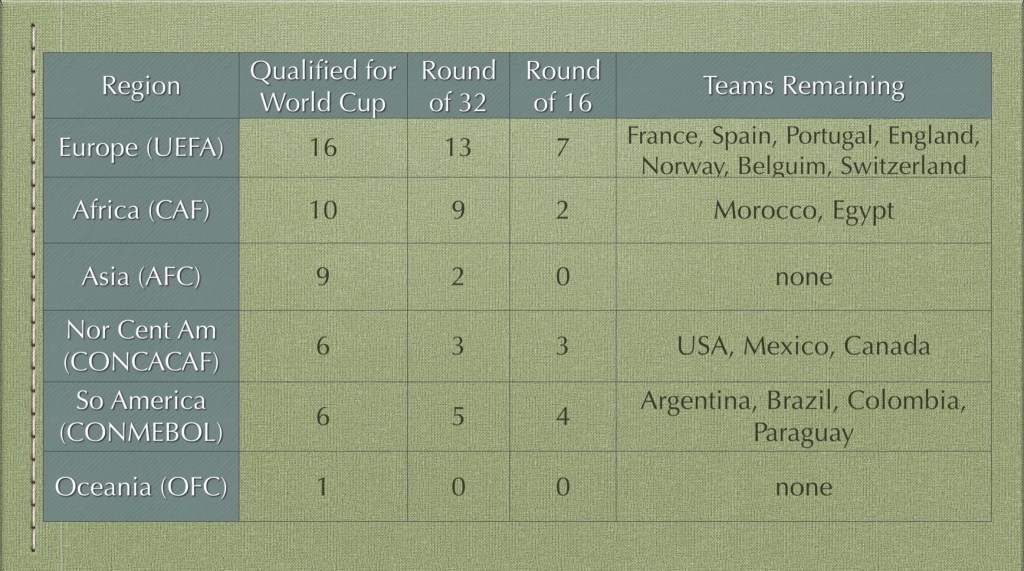
Of the 48 teams that qualified for the tournament, Europe (UEFA) remained the largest contributor with 16 nations. Africa (CAF) sent 10 teams, Asia (AFC) nine, North and Central America (CONCACAF) six, South America (CONMEBOL) six, and Oceania (OFC) one. After the group stage, 32 teams advanced to the knockout rounds. Europe led with 13 out of its 16 qualifiers, Africa produced an astonishing 9 out of 10, South America sizzled with 5 out of 6, Asia 2 out of 9, North/Central America had 3 out of 6, while Oceania’s lone representative, – New Zealand, bowed out.
And as we moved on to the round of 16, Europe continued to hold the most number of surviving teams with 7 out of 13. These are: France, Spain, Portugal, Norway, England, Belgium and Switzerland. Notably absent are Germany and Netherlands, victims of the upset axe wielded by Paraguay and Morocco respectively. South America has 4 out of 5 – Argentina, Brazil, Paraguay and Colombia; while North/Central America has the 3 hosts – the US, Canada and Mexico – still in the running. Africa suffered the largest number of casualties in the round of 32. It is represented now by only 2 teams: Egypt and Morocco. The Asia and Oceania regions are no longer in the running, after Japan and Australia were booted out in the round of 32.
These numbers tell a fascinating story.
Europe remains football’s unquestioned bastion. Seven of its sixteen teams survived the Group Stage and the Round of 32, underscoring the continent’s unmatched depth in coaching, youth academies, domestic leagues, and football infrastructure. It is no coincidence that the world’s strongest club competitions – the English Premier League, Spain’s La Liga, Germany’s Bundesliga, Italy’s Serie A, and France’s Ligue 1 – are all European. They continue to attract the best players and coaches from every corner of the globe, making Europe football’s ultimate destination and its finest classroom.
South America, meanwhile, continues to defy logic. With only six World Cup qualifiers, five reached the Round of 32, and 4 remain in the Round of 16. It is another reminder that football in South America is more than a sport – it is woven into the continent’s identity. Argentina and Brazil remain perennial contenders, but the depth displayed by the continent’s smaller nations confirms that its remarkable football culture continues to produce players of extraordinary technical ability.
Yet the tournament’s biggest winner may well be Africa. Nine of Africa’s ten representatives advanced to the Round of 32, a fantastic achievement that would have been almost unimaginable a generation ago. Of the 9, however, only 2 remain in the Round of 16. Still, it is clear that the African game has developed by leaps and bounds. The reasons are not difficult to find. Geography played a huge role in this. Africa’s proximity to Europe has enabled many of its brightest talents to develop in elite academies and compete regularly in the European continent’s top leagues. But proximity alone is not enough. African football has undergone a tactical revolution. Once stereotyped as relying primarily on athleticism, today’s African teams are more disciplined, more technically refined, and more tactically sound. Morocco’s historic run to the semifinals in the 2022 World Cup was not an isolated miracle; it triggered an even stronger interest in the sport, heralding the beginning of a new era. This World Cup also confirms that Africa is no longer simply producing outstanding players – it is producing vastly improved teams.
North and Central America also have reason to celebrate. Three of its six representatives – the United States, Mexico, and Canada – advanced to the round of 16. More important than the results, however, is the explosion of public interest across the host nations. Stadiums have been packed, television audiences have reached record levels, and football has captured the imagination of a region long dominated by American football, baseball, basketball, and ice hockey. In both the United States and Canada, the World Cup may prove to be less a sporting event than a cultural turning point, accelerating investment in youth development, professional leagues, and grassroots participation for years to come.
As for Asia, its football story is one of steady, guarded progress rather than a dramatic breakthrough. Only 2 teams advanced to the round of 32, only to be booted out. Japan has become a model of consistency, while nations such as Uzbekistan and Jordan, both making their World Cup debuts, symbolize the widening reach of the game across the world’s largest and most densely populated continent. Australia and South Korea are also slowly inching into the sport’s elite circle, reflecting years of investment in coaching, infrastructure, and youth academies.
Perhaps that is the most encouraging lesson from this World Cup. Football is no longer confined to its traditional heartlands. Knowledge now travels freely. A young striker from Cape Verde may learn his craft in France. A Japanese defender can develop his skills in Germany. A Canadian midfielder plays in England. A Ghanian tactician studies under Spanish coaches. The exchange of ideas, players, and philosophies have made the beautiful game richer and more competitive than ever before.
The old hierarchy has not disappeared – Europe still sets the standard. But the gap is shrinking. If this tournament has taught us anything, it is that football’s future will no longer belongs to one or 2 continents alone. It will belong to a world that has learned to speak the same language through the beautiful game.
Beyond the action on the pitch, the World Cup has once again demonstrated its remarkable power as a global gathering. Tens of thousands of supporters – particularly from Europe, where football culture runs deepest – have crossed the Atlantic to follow their national teams; filling hotels, restaurants, fan zones, tour spots and the city streets of the United States, Canada and Mexico. Host cities have been transformed into week-long festivals of music, food, and national colors, providing a significant boost to local tourism and businesses while introducing North American audiences to the vibrant, almost fanatical traditions of global football fandom. For a few precious weeks, the world’s attention has shifted from the relentless cycle of political headlines and international tensions to something far more uplifting. At a time when Americans have been preoccupied with debates over the economy, inflation, immigration, and the conflict involving Iran, the World Cup has offered a welcome respite, not by making these issues and challenges irrelevant, but by reminding millions that the sport – and all of sports for that matter – still possess a rare ability to unite people beyond political, cultural, and national divides. Inside the stadiums, there are no Republicans or Democrats; no Europeans, Africans or Americans; no blacks, browns or whites; only supporters bound together by ninety minutes of hope, hapiness, heartbreak, and the universal language of football.
Cover pic courtesy of The Times.


Even though I’m not a football fan, Donald Trump’s meddling in the FIFA World Cup disgusted me.
LikeLiked by 1 person
Very true. And look what his meddling has done. It has put the US team in a no-win situation. If they win, people will always say it’s tainted by political interference. It has also put FIFA in bad light, for having allowed politics to wield its ugly influence on the beautiful game. The move opened up a can of worms by having people now start to question all similar red card, hoping an appeal will solve things in their favor. Finally, it has placed the tournament in a very ugly, controversial situation. Fans now question the bias in the Argentina – Egypt game. There is a brewing discontent in the FIFA’S handling of the situation, and many football association are looking to oust Infantino.
LikeLike