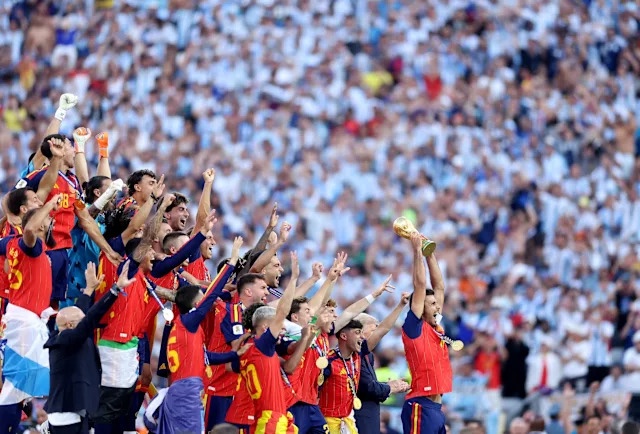
Spain reclaimed football’s highest prize Sunday night, outlasting defending champion Argentina 1-0 in extra time to capture its second FIFA World Cup title. It was a Final that remained scoreless for 105 tense minutes before substitute Ferran Torres banged home the decisive strike, finishing off a beautiful Spanish flow of passes to send the MetLife Stadium in East Rutherford, New Jersey into a frenzy.
While the scoreline suggested a closely-contested encounter, the match statistics painted a far different picture. Spain dominated the game, dictating the rhythm from the opening whistle by controlling roughly 68% of possession while limiting Argentina to just 32%. The European champs, La Roja, outshot the defending champions, La Albiceleste, by a huge margin, generating 20 attempts at goal compared to only 3 by Argentina. Even more remarkable, Argentina failed to register a single shot on target throughout the game, an unprecedented statistic for a World Cup finalist in the modern era. Spain produced 12 shots on target, and were it not for the brilliant goalkeeping of Emiliano Martinez – who collected a World Cup Finals record of 11 saves on target – Argentina would have fallen behind by a mile. Spain also completed more than twice as many passes, 762 to 358, patiently moving the ball from defense to attack while forcing Argentina to spend most of the evening chasing shadows.
If one player embodied Spain’s superiority, it was Rodri. Already considered the world’s finest holding midfielder, he produced another masterclass, completing passes at an astonishing success rate while shielding Spain’s back line with impeccable positioning. Rodri’s composure allowed Spain to dictate much of the phase of play, earning him the tournament’s Golden Ball as the competition’s outstanding player. Alongside him, teenage sensation Lamine Yamal constantly threatened Argentina’s defense with his pace, outstanding dribbling, and creativity, while young defender Pau Cubarsi delivered another mature performance far beyond his years. Goalkeeper Unai Simon was virtually a spectator for long stretches, a testament to Spain’s complete defensive control.
Argentina also deserves credit for reaching a second consecutive World Cup final. Despite the total Spanish domination in the finals, Lionel Messi once again inspired his country throughout the tournament, while Martinez’ outstanding goalkeeping prevented an even heavier defeat by producing a string of spectacular saves that kept Argentina alive until extra time. Without Martinez’ brilliance, Spain could have easily won by several goals.
Yet frustration gradually overtook Argentina as Spain’s relentless possession denied them the attacking rhythm they needed to have a fighting chance at a goal. The defending champions committed repeated tactical fouls in an effort to break Spain’s flow, and midfielder Enzo Fernandez would eventually be sent off after receiving a second yellow card late in regulation time. Following the final whistle, Argentina’s emotions spilled over further, resulting in additional disciplinary action. Argentina also declined to participate in parts of the customary post-match media obligations, adding to the disappointment surrounding an otherwise magnificent tournament run. While the passion of defeat is understandable, these unfortunate incidents inevitably overshadowed what had been an admirable World Cup.
Spain’s triumph was certainly no accident. Throughout the tournament, they conceded only 1 goal, the fewest ever recorded against a World Cup champion over a full campaign. Spain defeated Portugal (seeded 5th), Belgium (9th), France (3rd), and finally Argentina (1st) – arguably the toughest possible knockout path – while extending their unbeaten run to a record 38 international matches. Argentina, on the other hand, defeated Cape Verde (seeded 67th), Egypt (29th), Switzerland (19th) and England (4th) before facing off with Spain. Spain’s success was built not on one superstar alone but on a collective philosophy of intelligent movement, technical excellence, defensive discipline, and unwavering patience.
As another unforgettable World Cup comes to a close, its greatest legacy extends well beyond the trophy itself. For nearly six weeks, billions of people from every continent paused to celebrate the same game, speaking different languages perhaps, but sharing the same emotions – of hope, heartbreak, triumph, and respect. In a world too often divided by politics, conflict, and ideology, football once again reminded us that competition need not create enemies; at its best, it creates admiration. Viva, Espana!!! You have our utmost respect and love. But in the end, Spain may have lifted the World Cup trophy, but the tournament’s greatest victory belonged to the sport itself – a beautiful game that continues to unite humanity more powerfully than almost anything else.
Cover photo courtesy of Yahoo Sports.


Spain was most deserving of the Cup going into the match, and proved their worth wearing down Argentina in the end. As you noted, if not for the Argentine keeper the final might have been a rout.
LikeLiked by 1 person
Very true, Bruce. Spain dominated the game beautifully. And no amount of Argentinian thuggery could change the outcome in their favor.
LikeLiked by 1 person
Yes totally 💯 because they attacked Argentina most of the time and Argentina’s goalkipper Martinez saved a lot. otherwise Spain could scorel more.
LikeLiked by 1 person