(21st of ‘My Story’ Series)
When the 9th Scout Ranger Company (9SRC) jumped off for the hinterlands of Hilongos, Southern Leyte, the intelligence brief was grim. This was the ‘last bastion’ of the New People’s Army (NPA) in the province – an isolated mountain camp deep beneath a dense jungle canopy. The local PNP brought in a battalion of fresh, young police recruits to comb these jagged ridges multiple times, but the rebels were too slippery, always staying one step ahead, vanishing into the green forest whenever the police came near. Finally, the call went up to the Armed Forces of the Philippines: Send in the Rangers.
The first skirmish shattered the morning mist at 6:00 AM. Using the Rangers’ stealth, we had been able to close in without the local community alerting the rebels. However, we failed to come close enough to neutralize the outpost guard silently.
We lost the element of surprise with that first rifle shot. The enemy held the high ground, looking down on us from a narrow ridge with a single, treacherous pathway leading to their main camp. They hit back hard. We were pinned down instantly in a virtual killing zone. In those opening moments, a couple of gunshots tore through our ranks, and one of my men – Sgt Rodrigo Bosque – went down, severely wounded with a bullet through the thigh.
The 9th Scout Ranger Company now faced two urgent battles: the firefight unfolding on the ridge, and the desperate effort to save a wounded comrade who was losing blood fast.
Up on the ridge, a tactical crisis was unfolding. Knowing we couldn’t stay frozen under the enemy’s sights, I ordered an assault straight up the trail to push their lines back. I then tasked my Ex-O, 2Lt Julius Refran (PMA ’89) to organize a team to try to make a breakthrough on the right flank of the steep ridgeline. We needed to put pressure on them so that we did not remain sitting ducks on the ground below.
But barely a hundred meters up, my instincts flared. I reckoned that they would create an ambush area along that single pathway. I didn’t know it then, but we were nearing their prepared ambush area. As luck would have it, we were walking straight into the teeth of a possible slaughter when I held the advance and waited for Julius to make progress on the right flank.
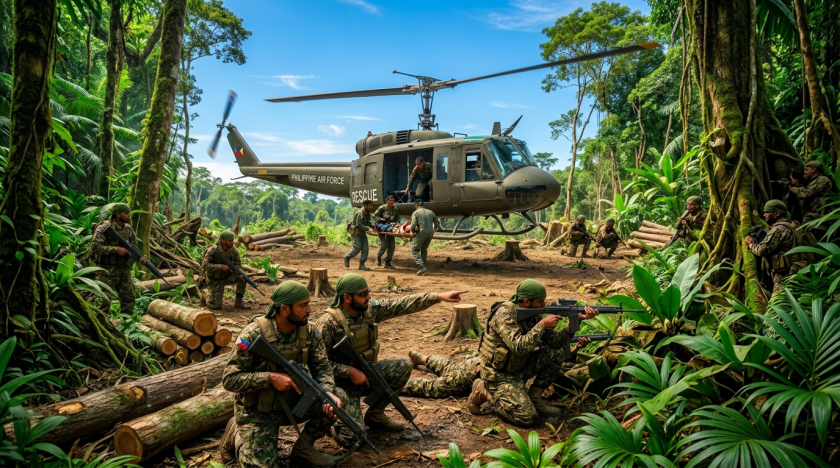
Concurrently, a secondary battle was happening just below us. We had to get our bleeding ranger out alive. 2Lt Arman Arevalo (PMA ’90) was tasked to lead the effort to get him medevac’ed safely. A team carefully brought our wounded buddy down to a relatively safer space. But “safe” was a relative term. The area remained risky, as it had not been cleared from possible enemy fire. Plus, there was the foliage and the dangerous overhanging trees that would make any heli effort tricky. With the firefight just a few hundred meters away, Arman’s men frantically swung their bolos, desperately carving out a makeshift landing zone from the raw jungle.
Then came the sound of helicopter blades echoing through the valley. It was Air Force Capt Tattu Sanchez (PMA ’79), letting us know that help was on the way. The clearing was barely large enough, with trees and underbrush crowding the approach and the surrounding ridges still hostile and uncertain. Yet, Tattu – a close mistah during our Plebe year under Charlie Company in PMA – would boldly manuever his chopper down into that tiny clearing, bringing her to the ground despite the threat of enemy fire, holding her steady just long enough to take our wounded Sgt Bosque aboard. Hearing the aircraft lift off, carrying our wounded buddy to safety, we had a momentary morale boost, even as we continued to exchange fire with a better-positioned enemy force.
With the medevac complete, we now focused on the deadlock on the mountain. This was when Julius took matters into his own hands.
Julius recognized the dilemma. The enemy had the advantage of the terrain, and pushing straight up the ridge’s only pathway would expose our men to an ambush. So he did something that required enormous courage: he made himself visible. From the opposite flank came the sound of Julius and his team with guns firing, moving aggressively up the ridge. Their sudden appearance forced the enemy to turn their attention away from us. And the balance would slowly shift.
Caught between my team temporarily halted on the main trail and Julius’ unexpected, audacious assault threatening their flank, the enemy’s plans were shattered. In danger of being cut off and now facing a two-pronged attack, the rebel rear guard broke their lines and retreated. By 5:00 PM, the guns finally fell silent. The ‘last bastion’ now belonged to us. As we occupied the rebel camp, we found a classroom, a hurriedly-abandoned tent area, and a burning kitchen area – all left behind hastily in their frantic flight.
For the next weeks, the hinterlands of Hilongos would become a relentless chess match. They launched sporadic probing attacks to try to reclaim lost ground. In one such engagement, we lost SSgt Greg Tacbian, sniped while inspecting our perimeter defense. His death was a stark reminder that danger in the mountains often came like a silent, solitary whisper. We struck back the very next day, recovering weapons with confirmed enemy casualties. But those numbers mattered less to us than the loss of Greg Tacbian. Greg was our conscientious logistics NCO, always ready to give everyone a helping hand. His loss was a deep blow to the 9th SR.
That brutal month vindicated my decision to leave the comforts of Camp Aguinaldo. Coming home, marching out from those dark woods, I would appreciate more clearly why General Abadia insisted that officers must first prove themselves in the trenches before aspiring for higher commands. For men do not follow rank. They follow credibility. They follow leaders who have carried the same heavy pack, walked the same knee-deep muddy trails, endured the same sleepless, shivering nights, and shared the exact same mortal dangers.
Out there in the mud, far away from the air-conditioned GHQ staff rooms, leadership ceased to be an abstract concept. I learned more about leadership because I watched these men practice it. I saw it in Arman as he led the mad rush to carve a landing zone under fire; I saw it in Tattu as he disregarded his own safety to extricate a seriously wounded soldier out of harm’s way; I saw it in Julius as he exposed himself to take the pressure off the rest of us; and I saw it in the quiet determination of my 9th SR after the devastating loss of Greg Tacbian. I joined the 9SR thinking I would lead these men. I found out later that these men would teach me what leadership was really all about.
When I left Camp Aguinaldo, I thought that I was sacrificing physical comfort to satisfy a professional requirement. I now returned with a better appreciation of what General Abadia’s words truly meant. The principle had come from him. But its meaning was poignantly delivered by the men who walked those mountains with me. It wasn’t about having another line on my service record, nor another medal on my chest. It was about acquiring the quiet confidence that comes from leading men when the stakes were highest – and knowing that they trusted me not because of the rank on my shoulders, but because I was there beside them when the guns were blazing.
For more on this, you can read back on “When Comfort Was No Longer Enough” (20th of My Story Series). Just Click on the title.


Thanks Charly for the great historical picture. And your comment, “Men do not follow rank. They follow credibility,” is one that our own Department of Defense should take into consideration. Blessings and Cheers
LikeLiked by 1 person
Thanks, Don.
The guy just turned it into a Department of War. He thinks it makes him look tough. I don’t think so. I think it just shows his insecurities.
LikeLiked by 1 person