(23rd of ‘My Story’ Series)
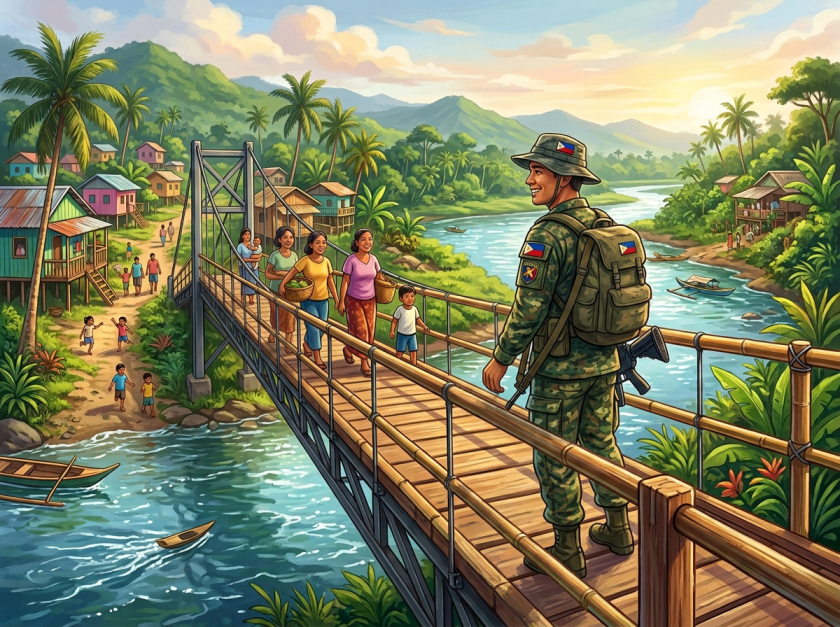
Befriending the children of Carmen opened up a whole new frontier for us. A period of relative quiet would settle over the area. The fields of Carmen and the neighboring towns seemed to be healing. And reports of armed elements grew less frequent. Instead, we saw more farmers returning to the land, planting and tilling their fields, while more produce began coming down from the mountains. The days seemed brighter, and there was a growing sense that things were getting better, however slowly.
Peace, however, was about to present us with an entirely different challenge.
It was during this time in Carmen when the Integration Program for the Moro National Liberation Front (MNLF) fighters was announced. President Fidel Ramos – my boss in a previous life in GHQ – had launched a bold program of reintegration for former Muslim rebels. In it, the Armed Forces of the Philippines was to absorb thousands of former rebels under the MNLF, and the Army Battalions would be tasked to prepare the foundation for its successful implementation.
I knew right from the start that this move to integrate former rebels into the ranks of the military would be a controversial issue for our troops. Having experienced many bloody encounters with the MNLF fighters, and having lost many of our comrades in these clashes, many of our troops were definitely not in favor of the integration process. It is easy to order former enemies to join together in a single organization. What is much harder is to persuade them to truthfully be one cohesive team.
Many questions arose. Could the memory of years of fighting simply be erased? Could we bury the suspicion between Christians and Muslims? How do I deal with the prejudice among my veteran soldiers – or with the fears of the former rebels? Could we be certain of their loyalty? And, perhaps most difficult of all, could we erase the invisible divide between “them” and “us”?
Ultimately, the question confronting us was simple: How does one welcome a man who may once have been shooting at soldiers like us – and now ask him to become our brother-in-arms? This nagging issue would demand so much self-reflection in the weeks and months ahead.
The decision, however, had already been made. Whether we welcomed it or not, the MNLF integrees were coming. Our task was no longer to debate the policy, but to prepare ourselves and make it work.
Hence, I made sure that the 3rd Infantry Battalion (3IBn) left nothing to chance. I knew that if we waited until the integrees arrived before preparing the Battalion, we would be facing enormous problems. Six months before the program was to be implemented, I gathered my men and told them that the 3IBn would soon absorb MNLF integrees into its ranks. There was hesitation at first. In fact, some openly disagreed. And I understood why. But I also told them that it was a done deal. The decision was not ours to make. What was ours was the responsibility to make it succeed.
We then began a program of reorientation within the Battalion. We confronted our own biases against Muslims in general and tried to better understand their culture, their traditions and values. We also prepared an orientation program for the incoming integrees – not just to explain the Battalion’s rules and routines, but to reassure them that the soldiers tasked to receive them were human beings much like themselves: men with families, ambitions, fears, disappointments, and dreams.
We also identified men within the Battalion whom we believed possessed the right temperament for the program. Each incoming integree would be paired with one of them – not as a guard, not as a handler, not as a watcher, but as his buddy.
This buddy would introduce him to battalion life, answer his questions, keep him from becoming isolated, and, we hoped, eventually become his brother and friend. This ‘buddy-system’ was perhaps the single most important innovation we introduced to make the integration program work.
Then, finally, they arrived: two officers and twenty-seven enlisted men, stepping down from the trucks that brought them into the 3IBn. We held a simple ceremony, introducing them to the rest of the battalion, and in turn, introducing to them the officers and key non-commissioned officers (NCOs) who would help guide them through their first days. There were awkward moments, of course. Both sides watched each other carefully, unsure of what to expect. But little by little, the tension began to ease.
That afternoon, knowing the power of sports to build relationships and break down barriers, we organized basketball and volleyball games to ease initial tensions. At first, there were the usual awkward and unfamiliar moments. These were men who had only recently been introduced to one another, carrying different histories and, in some cases, years of suspicion. But once the games began, things started to change. On the court, nobody cared where a man had come from. What mattered was whether he could make the pass, block the shot, spike the ball, and help the team win.
We soon discovered that, given the opportunity, some of our new integrees were quite talented athletes. That would come in handy when the 6th Infantry Division later held a mini-intramurals. While the other Battalions relied solely on their regular soldiers, our teams now included new integrees playing major roles. The 3IBn finished second in basketball and third in volleyball – a modest achievement perhaps, but one that meant more to me than the trophies themselves. Because by then, our men were no longer playing as regular soldiers and newly-minted integrees. They were wearing the same colors, cheering and fighting for the same team.
Maybe it was a small thing. But sometimes, unity begins in small episodes, and in unlikely situations. Before they could fully learn to trust one another as brothers-in-arms, they first had to learn to trust one another with a pass, a rebound, or a timely help on defense to stop a common opponent from scoring.
Our efforts to absorb them did not end inside the camp. We wanted the integrees to feel that they belonged not only to the 3IBn, but to the wider community. We brought them to Cotabato Provincial Governor Manny Piñol and Carmen Municipal Mayor Roger Talino, treating them not as former rebels under observation, but as men who had chosen a new place in society.
We also introduced them to the local Muslim community, hoping to weave them into the fabric of the area. We arranged transportation for their weekly religious services, and kept them occupied with meaningful activities. Little by little, we were able to create an environment in which the institutional walls built over years of conflict would finally begin to come down.
Word gradually spread about how the Muslim integrees in the 3IBn were being treated. Combined with what the communities had already seen with our trip to Davao with the Muslim children, this would further enhance the image of the Battalion as a unit genuinely focused on building peace rather than simply enforcing it.
Soon we started learning of MNLF integrees in other Battalions requesting for transfer to the 3IBn. At first, I found it a pleasant surprise. But word had spread – not through official reports or directives – but from the integrees themselves, through calls and texts with their fellow integrees.
For me, that was the most meaningful measure of our success. Integration had begun as an order from above. Somewhere along the way, however, it had started to become something more personal. The men we had once worried about receiving were no longer merely “integrees” and former adversaries. They were now becoming an integral part of our team, as true brothers-in-arms.
And just as we were beginning to understand what that trust could accomplish, the 3IBn was about to face a far more difficult test.
For more on this, you can read back on “The Children of Carmen” (22nd of My Story Series). Just click on the title.


Great write. You have me hooked.
LikeLiked by 1 person
Thank you, my new-found friend! Am glad you find the scribbles of an old man interesting. I shall endeavor to visit yours as well, Zeek.
LikeLiked by 1 person
Thank you my friend!
LikeLiked by 2 people