(24th of ‘My Story’ Series)
The children of Carmen had been of immense help to us in convincing the Muslim leaders of our clear intentions. The arrival of the MNLF integrees, and the favorable impression created in the way they were treated, further enhanced our reputation for pushing reconciliation and peace. Slowly, the 3rd Infantry Battalion’s efforts to create an environment conducive to economic development in Carmen and the adjoining areas were beginning to bear fruit.
Our modest success soon caught the attention of our senior commanders.
Late one evening, I was already fast asleep when the gate guard roused me. Major General Rudy Garcia, then Commander of the 6th Infantry Division (6ID), had arrived for a surprise visit. He had come with a heavy request: he wanted the 3rd Infantry Battalion (3IBn) to swap places with the Battalion then stationed in Buldon, Maguindanao.
General Garcia had taken a more than hour-long ride in the middle of the night to speak with me personally about his plan. He could have easily called me by radio. But this was not a conversation he wanted to have from a distance. He wanted to explain the mission himself, define what he expected of us, and impress on me the gravity of the work we needed to undertake.
After a brief discussion on what we had accomplished in Carmen, General Garcia asked if I would be willing to relieve the Battalion in Buldon.
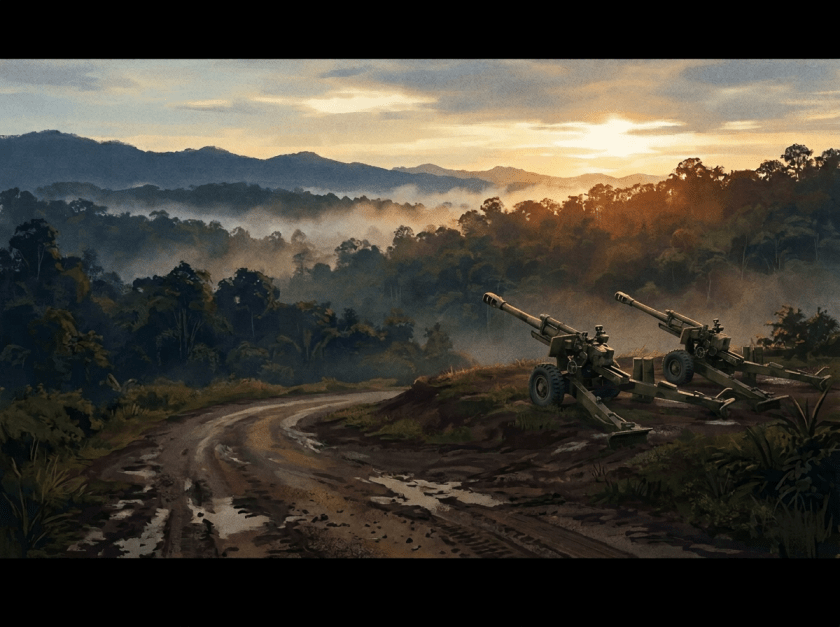
Buldon was notorious as the biggest stronghold of the breakaway Moro Islamic Liberation Front (MILF). The area had been locked in a vicious, seemingly endless cycle of violence, with soldiers and rebels trading shots without producing any meaningful effect. As a result, the unit stationed there was an oversized Battalion, equipped with considerably heavier firepower than a regular Battalion.
My mission, as General Garcia put it, was simple: “Stop the shooting in Buldon.”
He needed the guns to fall silent so that the ongoing peace talks in the neighboring town of Datu Odin Sinsuat could move forward.
Of course, there was really no saying no to such a “request.”
The following day, I sent a team ahead to Buldon to observe the situation and learn as much as they could about the environment we were about to enter. At the same time, I began preparing the Battalion for the eventual transfer.
Three days later, the team returned with its report.
Their most striking observation was the rampant practice of recon fire in the various detachments. Guards would often fire indiscriminately at any sound or slight movement outside their perimeter. Sometimes, those shots would trigger an exchange of fire that could last up to an hour. The shooting kept everyone on edge – not only the soldiers and the rebels – but also the families living nearby. The barking guns had almost developed a life of their own.
Just before our deployment to Buldon, I was called back to Manila for a meeting with no less than the then AFP Chief of Staff, General Joselin Nazareno. A respected Mindanao warrior and statesman, General Nazareno wanted to speak to me candidly about the stakes of our next assignment.
He reiterated the mission General Garcia had given me: stop the senseless shooting. He then took pains to explain what he called the cold economics of war.
Over the previous seven months, the Army had used up close to a thousand rounds of 105mm howitzer ammunition, along with thousands of rounds of lower-caliber ammo, costing millions of pesos. Yet all that firepower had produced no significant result on the ground. No bodycount, no surrenders, no area seized, no firearms nor other war equipment confiscated. Logistically, it was a losing proposition – an enormous and unsustainable drain with nothing gained.
General Nazareno believed that the only way to break this cycle was to move away from brute force and put an end to what had become, in many ways, an acoustic war – a war in which the sound of guns had become almost as important as the results they wanted to produce. If we could stop the shooting, General Nazareno believed that we would be able to help create the space needed to make the fragile peace talks in nearby Datu Odin Sinsuat succeed.
So we marched off to Buldon and did exactly that. The reckless practice of nighttime recon fire was immediately banned. But before we transferred, I challenged my men. I reminded them that they were better equipped, better trained, more disciplined, and more mature. Mature enough to understand that firing blindly into the darkness did not make anyone safer. My ask: what have they to be scared of?
What the troops needed was not more bullets. They simply needed to build a stronger perimeter; they needed to have alert sentries; they needed good security procedures; and sometimes, they needed nothing more complicated than a handy flashlight. There was no reason to waste ammunition on every rustling leaf or unexplained sound in the night.
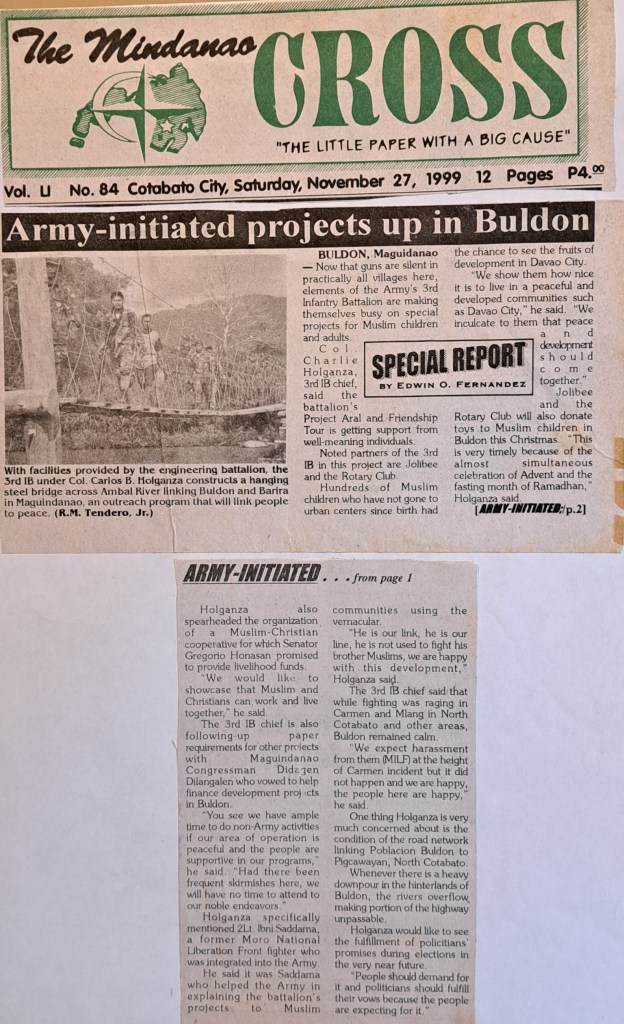
At the same time, we made full use of the MNLF integrees whom we had so carefully nurtured in Carmen. We gave our integrees important responsibilities and allowed them to demonstrate what they could do. In return, they stepped into their duties with pride and loyalty. More importantly, they became our bridge to the local communities. The lessons we had learned in Carmen were now proving their worth.
Slowly, the environment in Buldon began to change. Families who had once slept close to the foxholes they had prepared began sleeping peacefully inside their homes once again. The children, as they had in Carmen, became some of our earliest friends. Many of them had never been to Cotabato City, and joining our trucks during our regular marketing runs became a small adventure for them. It was a simple gesture, but we had learned that small gestures often made lasting impressions.
And then we noticed something even more significant. The chatter over the rebel radio communications began to diminish. The silence did not come all at once. At first, there were still a few exchanges. Then the stretches of silence grew longer.
Later, we would discover another piece of the puzzle. Much of the violence in Buldon had not been driven solely by ideological or military objectives. There was also a deeply personal dimension to it. The MILF fighters in the area had developed what the local communities called a ‘rido’ with the Battalion we had replaced.
A rido is a deeply rooted personal or clan feud in which one act of violence invites another, and retaliation can continue until both sides believe that some form of balance or retribution had been achieved. In this case, the fighters did not simply see the Army as one faceless institution. They had developed a particular animosity toward the unit previously stationed in Buldon.
When that Battalion moved to Carmen and the 3IBn took its place, something unexpected happened. The guns seemed to follow the old relationship. The fighters had little interest in creating the same cycle of retaliation with us. Their quarrel, it appeared, was with their old “dance partner.”
This realization was both revealing and humbling. We had arrived believing that we were entering a battlefield defined by broad military and political forces. Instead, we discovered that some of the violence had also been sustained by relationships, bitter memories, personalities, and old grievances that had taken on a life of their own.
By refusing to answer every sound with gunfire, by strengthening our defenses without provoking unnecessary exchanges, by using our MNLF integrees to build bridges with the community, by befriending the local community – especially the children – and finally, by arriving without the emotional baggage of the unit we had replaced, we were able to change the atmosphere in Buldon. All these factored well together.
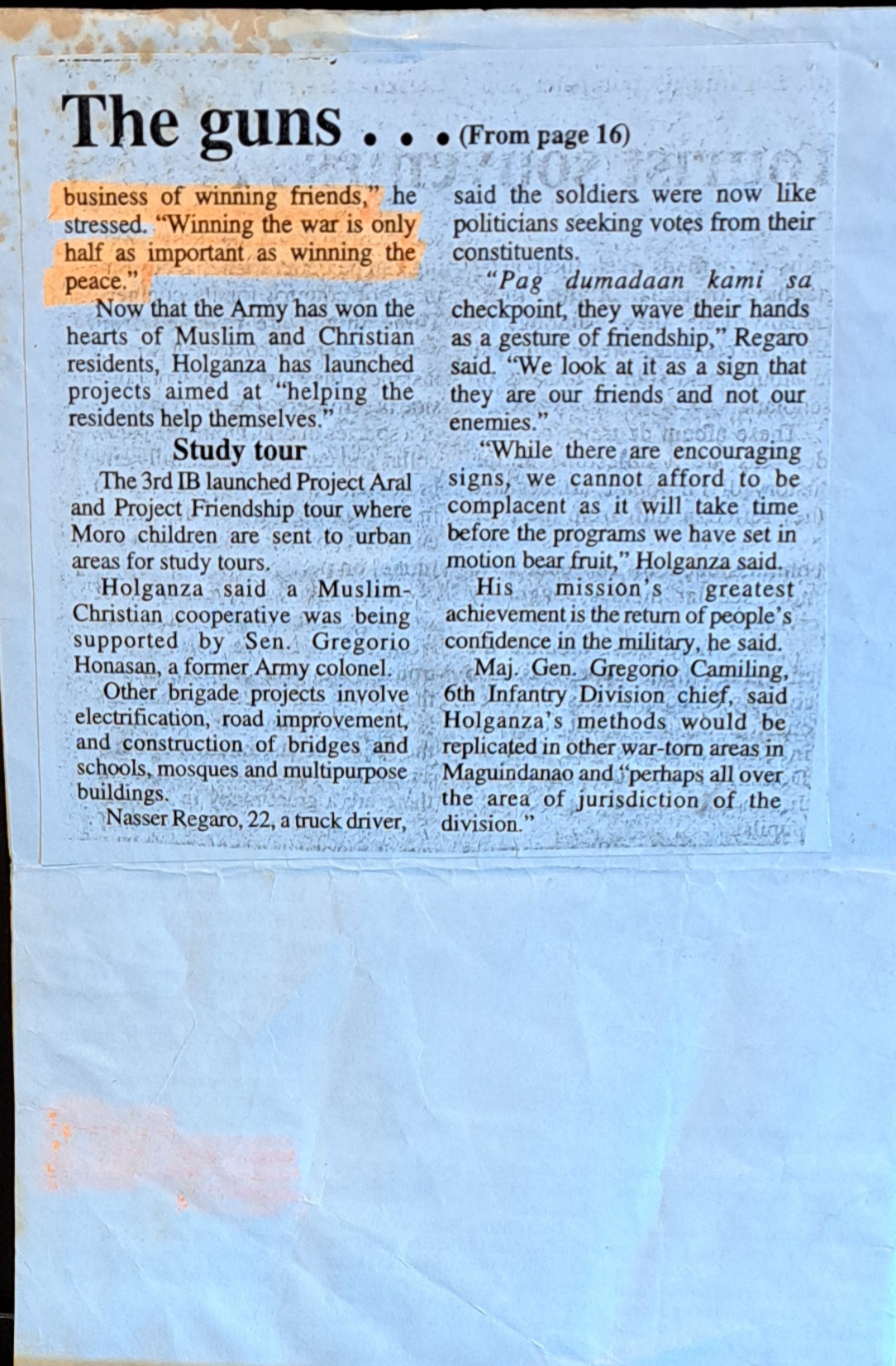
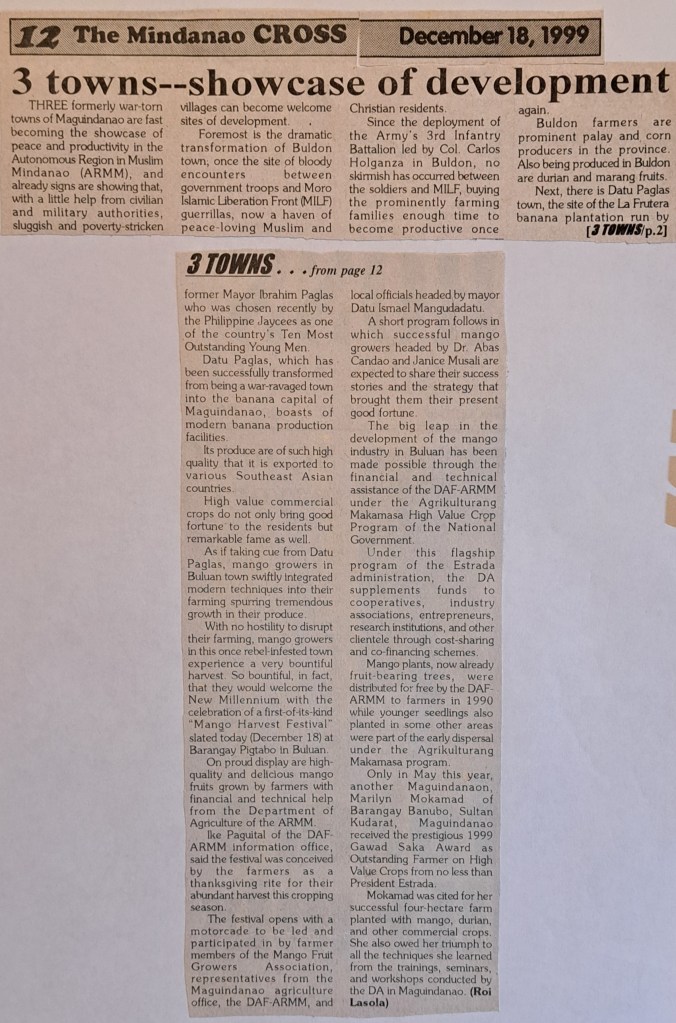
Eventually, a national newspaper would feature the 3IBn for “silencing the guns of Buldon.”
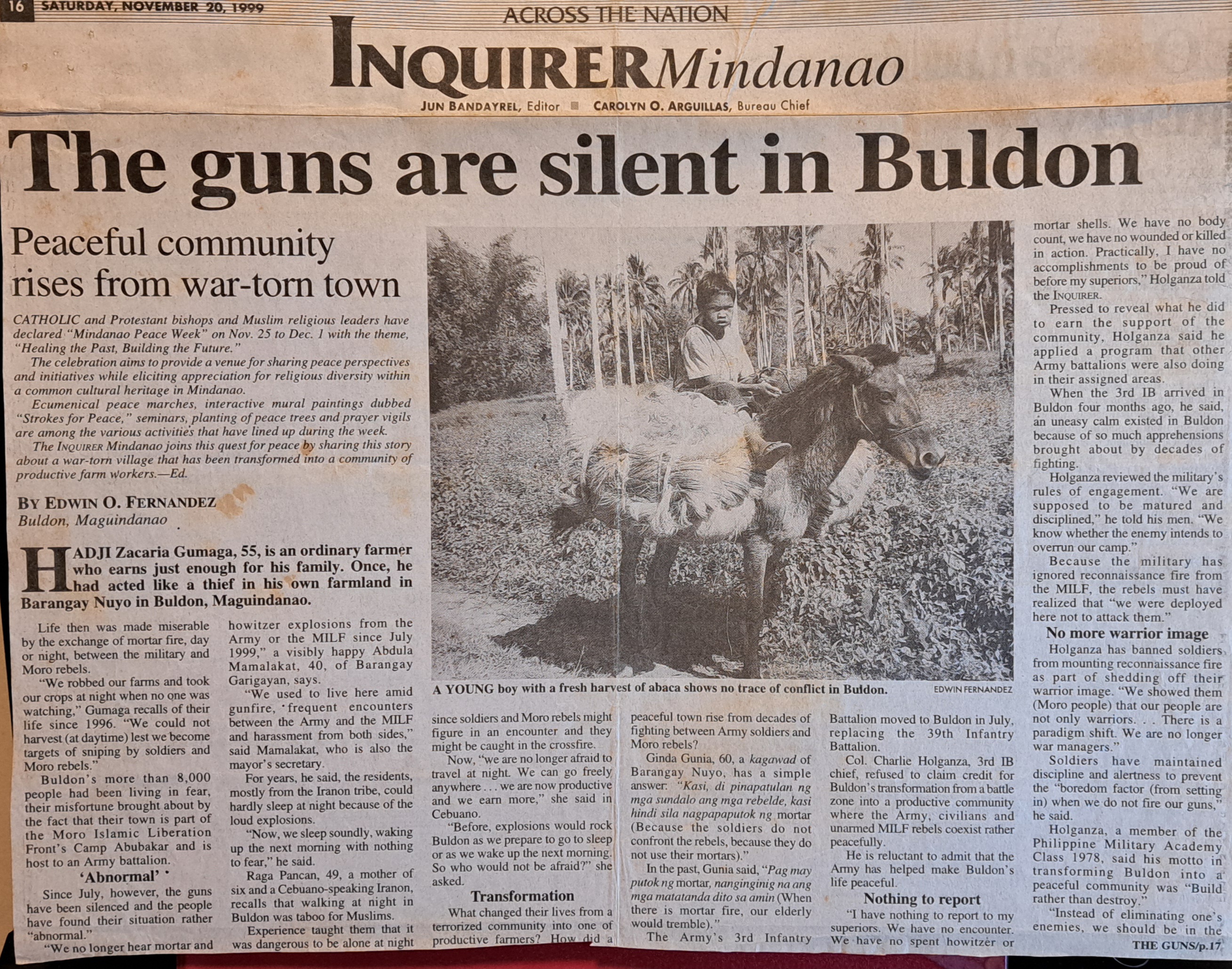
But I knew that the achievement was never ours alone. Peace had not come because we had defeated anyone in battle. There had been no dramatic surrender, no triumphant assault, and no enemy flag brought home as a trophy.
Instead, we had simply changed the conditions that kept the shooting alive.
Buldon taught me that peace is not always achieved by defeating an enemy. Sometimes, peace happens when you just give people enough reason to stop being enemies in the first place.
Not long after, the winds of change blew my way once again. Out of the blue, my classmate, then Col. Delfin Bangit, called to ask if I could relieve him as he prepared to leave for a schooling opportunity in Australia. His call would bring my stint with the 3IBn to an end.
But as I prepared to leave the Battalion, I carried with me lessons that would remain long after the guns of Buldon had fallen silent.
In Hilongos, I had learned that leadership meant sharing the risks and hardships of the men you lead. In Carmen, I learned that trust had to be earned before peace could flourish – not only among your own people, but with the community and even with those who once stood on the other side. And in Buldon, I came to understand the true meaning of Sun Tzu’s famous principle: “To subdue the enemy without fighting is the supreme excellence.”
It was in Buldon that I learned perhaps the more significant lesson of all. You can spend a fortune trying to destroy an enemy. Or you can spend time trying to understand why he is fighting – and perhaps discover a way to make him stop.
And that experience would permanently alter my worldview.
More than ever, I became convinced that development – not destruction and domination – offered the surest path toward lasting peace. A community that begins to enjoy the warmth of electricity after dark, the security of a functioning clinic, the hope offered by a good school, and the opportunity to earn a decent living – all these provide a dream for a better future.
And when people begin to see a bright future, violence slowly loses its meaning – and its tragic hold over them.
Buldon taught me that peace is not always achieved by defeating an enemy. Sometimes, peace begins when you give people enough reason to stop being enemies in the first place. Winning the war, I learned, is not always what matters. What matters more is winning the peace.
For me, that was the greater victory.
For more on this, you can read back on “From Enemies to Brothers in Arms” (23rd of My Story Series). Just click on the title.
For a closer look, just click on the pics.


One comment